
ISPE Nordic – Saunders® Overview:
Cleanability by Design is Now Central to Risk and Capacity
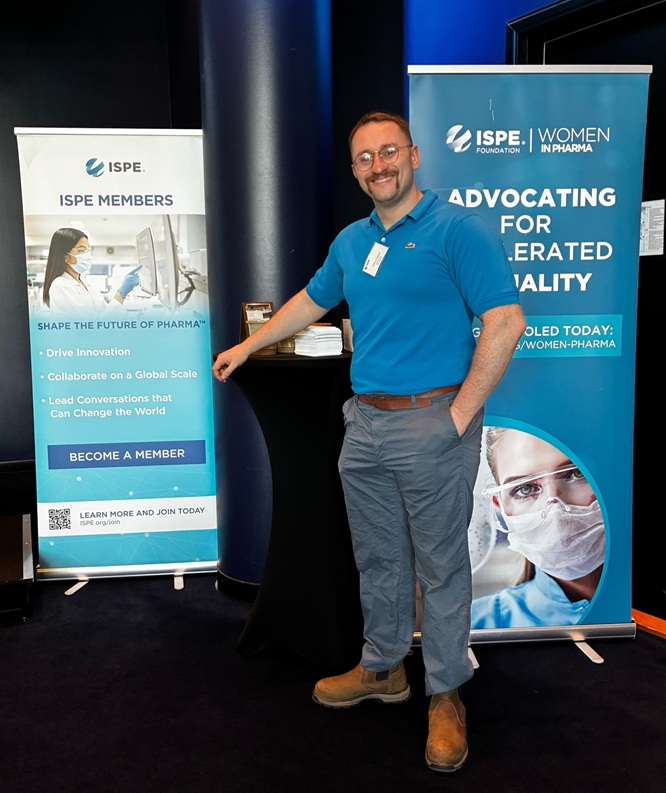
Miles Capper, Pharma Application Specialist at Crane Saunders, attended the ISPE Nordic Cleaning and Sterilization Conference in Helsinki (June 15-17). One message was consistent across regulators, end users, and suppliers:
The biggest risks in cleaning and sterilization are determined at the design stage—not during validation.
From Compliance to Defensible Decisions
The industry is moving away from “tick box” compliance toward more risk based and justifiable approaches. Regulators are increasingly focused on whether decisions are logical, representative, and clearly documented.
A recurring theme was that data alone is no longer enough. It must be backed by sound, defensible rationale. For project delivery, this reframes how risk is managed:
Risk is reduced by the quality of design decisions, not the volume of documentation.
Cleanability is a Critical Design Input
A consistent theme was that cleanability must be engineered in from the outset. Common validation challenges such as poor sampling access or undefined worst-case conditions often originate in early design stages.
The impact is measurable:
- Dead legs significantly increase cleaning time and complexity
- Poor geometry directly increases validation complexity and operational risk
Once built, these issues are difficult to correct without redesign, rework, or extended validation effort.
Designing for cleanability early is one of the most effective levers for reducing risk in complex projects.
Cleaning performance defines capacity
Cleaning is no longer just a validation consideration. It is a constraint on capacity.
Industry examples highlighted that:
- A significant portion of purified water consumption is driven by CIP
- Cleaning can be a major contributor to lost productive time in biologics facilities
At the same time, optimised systems have shown:
- Meaningful reductions in water and chemical usage
- Significant reductions in cycle time, with cleaning moving from multi day processes to less than 24 hours
This reinforces a critical point:
Designing for cleanability enables capacity and directly improves operational efficiency.
Annex 1 reinforces design accountability
Annex 1 expectations, including sterile boundary integrity, PUPSIT, and defined testing strategies, are driving the need for solutions that are built into system design.
Systems must now be:
- Designed with access to worst case locations
- Configured to enable repeatable and verifiable testing
This increases the importance of design quality and clarity of specification.
The strategic takeaway
The industry position is clear:
Low risk, high-performance operations are built through design led decision making early in the project lifecycle.
For complex project environments, this creates a clear opportunity to:
- Reduce validation risk and operational uncertainty
- Improve delivery predictability
- Ensure systems can operate at designed throughput from day one
At Saunders, this aligns with our focus on supporting customers through cleanability driven design, enabling predictable delivery and reliable long-term performance.
Contact us for more information: CLICK HERE
For additional information, please visit our Crane ChemPharma & Energy LinkedIn page, or, to learn more about Crane ChemPharma & Energy, please visit www.cranecpe.com.
About Crane ChemPharma & Energy
Crane ChemPharma & Energy (within Crane’s Process Flow Technologies segment) designs and manufactures a variety of high-performance products, including valves, pipes, actuation and fittings to name a few. Their trusted brands ALOYCO®, BAUM®, CENTER LINE®, COMPAC-NOZ®, CRANE®, CRANE® CRYOGENICS, CRYOWORKS®, DEPA® & ELRO®, DOPAK®, DUO-CHEK®, FLOWSEAL®, GYROLOK®, GO REGULATOR®, HOKE®, JENKINS®, KROMBACH®, NOZ-CHEK®, PACIFIC VALVES®, RESISTOFLEX®, REVO®, SAUNDERS®, STOCKHAM®, TECHNIFAB®, TEXAS SAMPLING®, TRIANGLE®, UNI-CHEK®, VALVES®, WESTLOCK CONTROLS®, WTA®, and XOMOX® offer customers a complete and innovative portfolio, designed for the most demanding chemical processing, biotechnology, pharmaceutical, oil and gas, refining, power generation, and energy transition applications. For more information please visit: www.cranecpe.com